Your business,
on autopilot.
One platform for creating, running and growing your business, powered by AI.
What Is an Autonomous AI Company? The 2026 Definition, Levels, and How to Build One




Last updated: May 2026
An autonomous AI company is a business where AI agents do the work, not a human team. The owner sets the mission, funds the budget, and reviews the results. The company itself, however, runs continuously: it builds products, ships marketing, replies to customers, reads its own dashboards, and decides what to do next.
This is not a thought experiment. SAP just renamed its strategy around it. ServiceNow announced an "autonomous workforce" at Knowledge 2026. Indie founders are quietly running businesses with the same architecture at one-thousandth the headcount. The category is real, and it is shipping.
Here is what an autonomous AI company actually is, where it sits on the autonomy spectrum, what works in May 2026, and what you can build today.
- The short definition: A business whose core operating loop is executed by AI agents, with a human as owner and arbiter rather than operator.
- Five levels of autonomy: From AI-assisted (L1) to fully self-directed (L5). Most "autonomous" companies in 2026 live at L2 or L3.
- What's real today: Content ops, lead generation, customer triage, storefront management, marketing execution. Reliable in narrow scopes.
- Where it breaks: Legal accountability, brand judgment, irreversible decisions, regulated relationships. A human still owns these.
What Is an Autonomous AI Company?
An autonomous AI company is a software entity where AI agents fill the roles a human team would normally fill: operations, marketing, sales, support, finance, product. The agents run continuously toward a defined goal, usually some version of "grow revenue without going broke." A human owner sets that goal, holds the legal entity, and intervenes when the system asks for help. Everything else, the company does itself.
This is a different thing from any of the components people often confuse it with:
| Category | What you do | What it does | Example |
|---|---|---|---|
| AI tool | Operate it for a single task | Returns task output | ChatGPT, Midjourney |
| AI agent | Hand it a goal | Plans, calls tools, returns a result | A Lindy agent that books meetings |
| Workflow automation | Wire steps together | Runs the same sequence repeatedly | Zapier, n8n, Make |
| AI business builder | Describe what you want to sell | Builds the business infrastructure | Crevio, Durable |
| Autonomous AI company | Set the mission and budget | Runs the business continuously | The architecture this post is about |
The simplest way to spot one: a human can leave for a week and the business will still ship, sell, and respond to customers without anyone covering for them.
An AI agent is a single worker. An autonomous AI company is the long-running organization that schedules many agents toward a single business goal, accumulates memory across their runs, and reports back to one human owner. The difference is structural, not just a matter of degree.
The 5 Levels of Autonomy
Self-driving cars settled on a 6-level scale (L0 through L5) because "autonomous" is a spectrum, not a binary. Autonomous AI companies are heading the same way. Here is the most useful version of that scale in 2026.
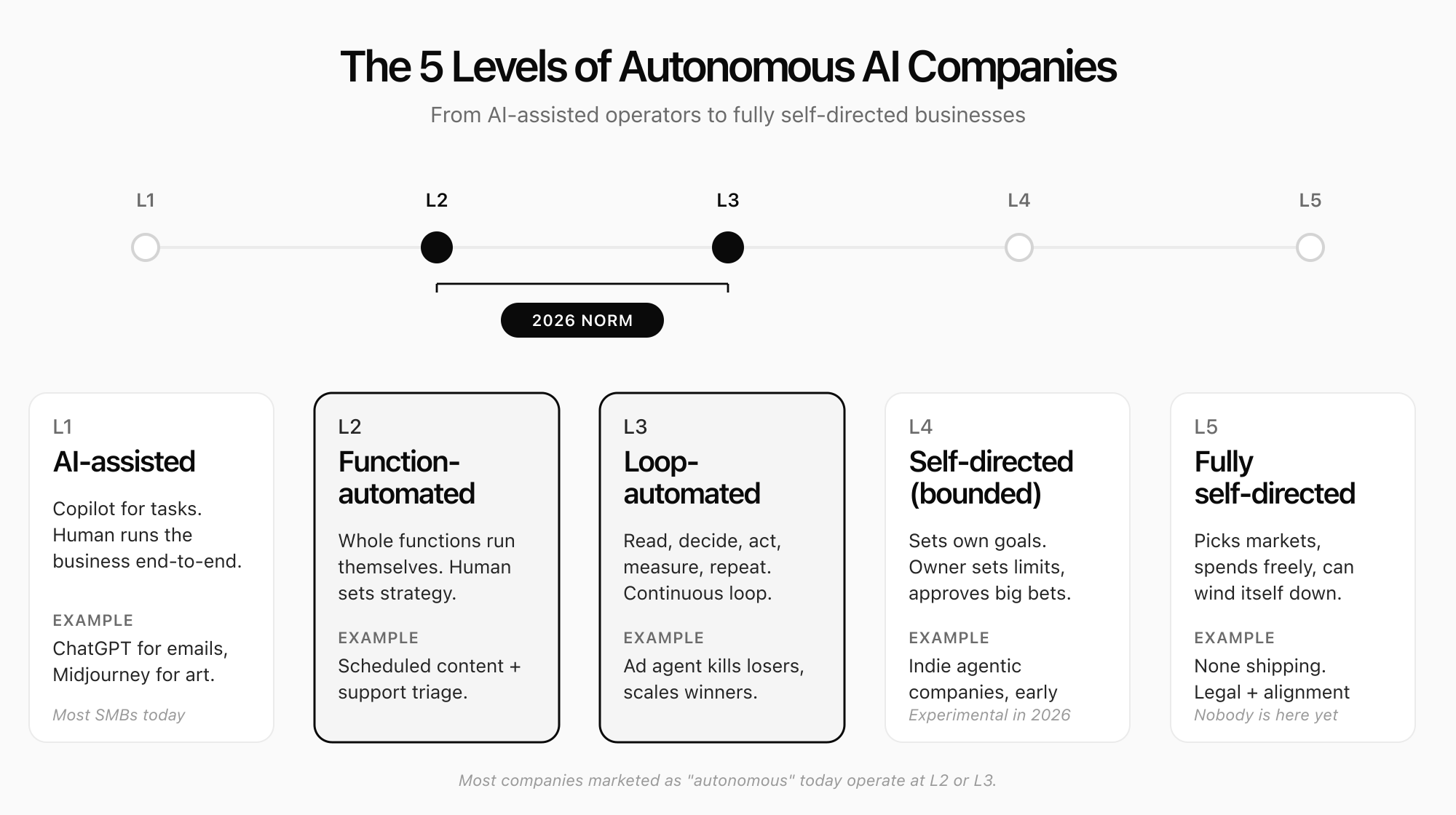
L1, AI-assisted. A human runs every part of the business. AI is a copilot for individual tasks: drafting emails, summarizing reports, generating images. The human still decides what to do, when, and why. Most small businesses operate here today.
L2, Function-automated. Specific functions run themselves end-to-end. Marketing posts go out on a schedule and respond to performance. Inbound support is triaged and answered by an agent. The human still chooses strategy, approves campaigns, and handles anything unusual. The 2026 frontier for most solo founders is here.
L3, Loop-automated. The business has a continuous operating loop: agents read analytics, propose next moves, execute approved actions, measure results, and try again. Humans set quarterly direction and approve large changes. This is where "running itself" starts to feel literal.
L4, Self-directed within boundaries. The company sets its own short-term goals, allocates its own budget across them, and picks its own tactics. Humans set hard constraints (don't enter regulated markets, don't spend over X) and approve big bets. The owner is closer to a board member than an operator. A handful of indie companies are experimenting here.
L5, Fully self-directed. The company makes all strategic decisions, including which markets to enter and when to wind down. The human role is roughly that of a shareholder. Nobody is here in 2026. It is unclear if anyone should be, given current alignment and legal accountability gaps.
The honest 2026 reality: most companies marketed as "autonomous" sit at L2 or L3, with a few pushing into L4 for narrow domains. That is still a meaningful shift. A business that operates the marketing function, the storefront, and tier-one support without daily human input is a different kind of company from one that needs an operator at the desk to function.
What an Autonomous AI Company Actually Does
Strip away the framing and an autonomous company is doing the same seven jobs any business does. The difference is who does them.
| Function | What it does | Who runs it in an autonomous AI company |
|---|---|---|
| Product | Builds and updates what you sell | AI agents draft, edit, publish |
| Storefront / website | Hosts the offer and handles checkout | AI builder + ops agent maintain it |
| Marketing | Acquires attention | Content, ad, and social agents |
| Sales | Converts attention into revenue | Funnel agent + lifecycle agent |
| Customer support | Keeps customers happy | Triage agent + escalation policy |
| Analytics | Tells the business what is working | Reporting agent + decision agent |
| Strategy | Decides what to do next | Human (today) |
That last row is the load-bearing one. We covered the full breakdown of what an AI can and can't run today in Can AI Run a Business?. The short version: six of the seven jobs are now AI-led for small online businesses. The seventh, strategy, is where the human still owns the outcome.
What Works in Production Today (May 2026)
There is a lot of marketing copy about agents that "run your entire enterprise." There is much less honesty about which parts actually work without supervision. From what is shipping in production right now:
Reliable at L2-L3 today:
- Content operations. Research a topic, draft a post, schedule it, measure performance, queue the next one. Newsletters, blogs, and social feeds run this way at scale.
- Lead generation and outreach. Find prospects from public data, enrich, draft a personalized first touch, log replies. Works well when the target list is narrow.
- Inbox triage and tier-one support. Read the email, classify intent, draft a reply, send if confidence is high, flag if not. Works for high-volume, low-stakes support.
- Storefront and product setup. Generate product pages, configure payments, build a checkout, launch a landing page. AI business builders do this end-to-end.
- Paid ads management. Generate creative variants, run them, kill the losers, scale the winners. Works inside narrow budget guardrails.
- Reporting and weekly summaries. Pull from analytics tools, write the narrative, flag the anomalies, suggest the next experiment.
Not yet reliable without a human:
- Legal accountability. No agent can sign a contract, own a bank account, or be sued. The human owner is still the legal entity.
- High-stakes irreversible actions. Big refunds, public statements during a crisis, legal disputes, deplatforming a customer.
- Brand judgment under pressure. When a launch goes sideways or a topic becomes politically charged, taste and timing are still human jobs.
- Strategic pivots. Deciding when to change product, market, or pricing model. Agents can suggest. Humans still decide.
- Regulated relationships. Healthcare, finance, and similar verticals still require a licensed human in the loop for most customer-facing actions.
If you treat the second list as the human's job description and the first list as the company's, you have a viable autonomous AI company in 2026.
The Economics: When Does This Actually Make Sense?
The interesting question is not "can a company run itself." It is "for which businesses does this beat hiring people." The honest answer in May 2026 is: most small online businesses, and a growing slice of mid-market.
The case for an autonomous setup is strongest when:
- The work is digital end-to-end. No warehouses, no fulfillment, no on-site service. AI agents struggle with anything physical.
- The decisions are reversible. Marketing copy, ad creative, product pages, support replies. Cheap to be wrong, easy to fix.
- The volume is high enough to matter. Agents shine on the 100th task, not the 1st. If you have one customer a month, do it yourself.
- The margin is good. AI inference, tooling, and platform fees stack up. Thin-margin businesses get squeezed.
The case for hiring people is strongest when:
- The relationship is the product. High-touch sales, coaching, anything where the buyer wants a human on the other end.
- The stakes are large and personal. Legal, medical, financial advice. The agent can draft; a licensed human still ships.
- The work requires taste at a level current models do not have. Brand strategy, designed objects, original creative work.
We did the full breakdown in AI Business Builder vs. Hiring a Team. The headline number: for digital product businesses under roughly $5M in revenue, an autonomous setup is now both cheaper and faster than the human-team equivalent for the operational jobs. Strategy and original work still benefit from humans, but the org chart underneath them is shrinking.
How to Actually Build One
There are two practical routes in 2026, and they are aimed at very different people.
Route 1: The enterprise stack
Companies like SAP and ServiceNow are wiring autonomous agents into existing ERP, CRM, and ITSM systems. The pitch is reasonable: most large enterprises have decades of process embedded in those platforms, and rebuilding it elsewhere is impractical. SAP's Autonomous Suite deploys what it calls Joule Assistants across finance, supply chain, procurement, HR, and customer experience. ServiceNow's announcement is the same idea aimed at IT and operations.
If your business already runs on SAP or ServiceNow, this is the path. Expect long deployment cycles, a real implementation budget, and meaningful governance work. The upside is depth: these systems plug into the data and processes that already exist.
Route 2: The solopreneur and SMB stack
For everyone else, especially anyone building a digital product business from scratch, the practical path is an AI business builder plus a small set of integrations.
The components:
- An AI business builder that handles storefront, products, payments, and customer data. Crevio, Durable, and Polsia are the names in this category. We benchmarked all of them in AI Business Builder: 8 Platforms Compared.
- Specialist agents for the functions that are not part of the builder. Lindy for operations workflows, agent-style email tools for outreach, scheduling, and CRM updates.
- A shared data layer. The agents need to read from and write to the same customer and product records. The builder usually provides this through an API.
- A human-in-the-loop policy. A clear, short list of decisions that always come back to you. Refunds over $X. Public statements. Anything legal.
The setup time for this stack in 2026 is hours, not months. The total monthly cost is usually well under a single employee's loaded cost.
How Crevio Fits
Crevio is built for the solopreneur and SMB route. The category we are building toward is the autonomous AI company, but the practical product today sits at L2-L3 on the autonomy scale: AI that builds your storefront and products, runs your marketing, handles customer messages, and surfaces what to do next. You stay in the loop for strategy and the decisions that need a human.
The economics are designed for the "describe what you want to sell, AI builds and runs it" pattern:
- Free Starter plan with 5% transaction fees and 250 AI credits per month. Enough to validate an idea without spending anything.
- Pro at $20/mo drops fees to 2.5% and adds 1,000 monthly credits. Right for most early-stage solo businesses.
- Business at $50/mo is 1% fees, 2,500 credits, custom domain, and removed Crevio branding.
We are honest about where we sit on the autonomy scale. Crevio is not a fully self-directed company at L5. No platform is. What it is, today, is an AI business builder with agents that get more autonomous over time, on a stack that is meant to run a real business without a five-person team. The vision is full autonomy. The product today is the most useful version of that vision that actually ships.
For the broader category map, including how the platforms differ in approach and pricing, see AI Business Builder: 8 Platforms That Actually Build and Run Your Business.
The Risks and What to Watch For
An autonomous AI company is not a risk-free architecture. The serious failure modes:
- Mission drift. Agents optimize for the metric you give them, not the goal you meant. "Maximize signups" without a quality constraint produces signups that never convert. Define the constraints as carefully as the objective.
- Cascade errors. One bad decision early in a chain can compound for hours before a human notices. Hard spending caps and rate limits are not optional.
- Reputation events. A confidently wrong public reply at 2am is still a reply your customers will see. Tier-one support agents need clear escalation rules and a hand-off policy.
- Legal liability. The agent did not sign the contract. You did. Treat agent outputs in regulated contexts the way you would treat a junior employee's draft: review before it goes out.
- Lock-in. If the entire business runs inside one vendor with no API and no data export, you are not running the business; the vendor is. This is one reason we built Crevio with a full REST API and no lock-in. The question is worth asking of any platform you choose.
Governance is the unsexy part of this category and the part most teams skip. Raconteur's coverage of the 2026 rules is a useful overview if you want to go deeper.
Why Now: The 2026 Inflection
Three things changed in the last 18 months that made this category actually viable, not just plausible.
- Long-horizon agent coherence. The current frontier models can plan and execute over hours and days without losing the thread. A year ago, "long-horizon" meant "the agent did not get confused within a 10-step task." Today it means a coherent week of work.
- Cheap sandboxing. Running an agent in a container with internet access, a credit card, and the ability to call tools costs cents per hour. The infrastructure that makes the architecture possible is now a commodity.
- Standardized tool protocols. Model Context Protocol (MCP) and similar standards mean an agent can use the same Stripe, the same email platform, the same analytics tool that a human would use, without custom glue per integration. The integration tax dropped sharply.
A Deloitte survey cited by Raconteur found close to 75% of businesses plan to deploy AI agents by year-end. Adoption is going to outpace the discourse for a while. The companies that build the muscle now will look obvious in retrospect.
FAQ
Related Blog Posts
What will you sell today?
Describe what you want to sell — Crevio builds, launches, and grows it. Products, payments, and marketing, all on autopilot.
Start for free